


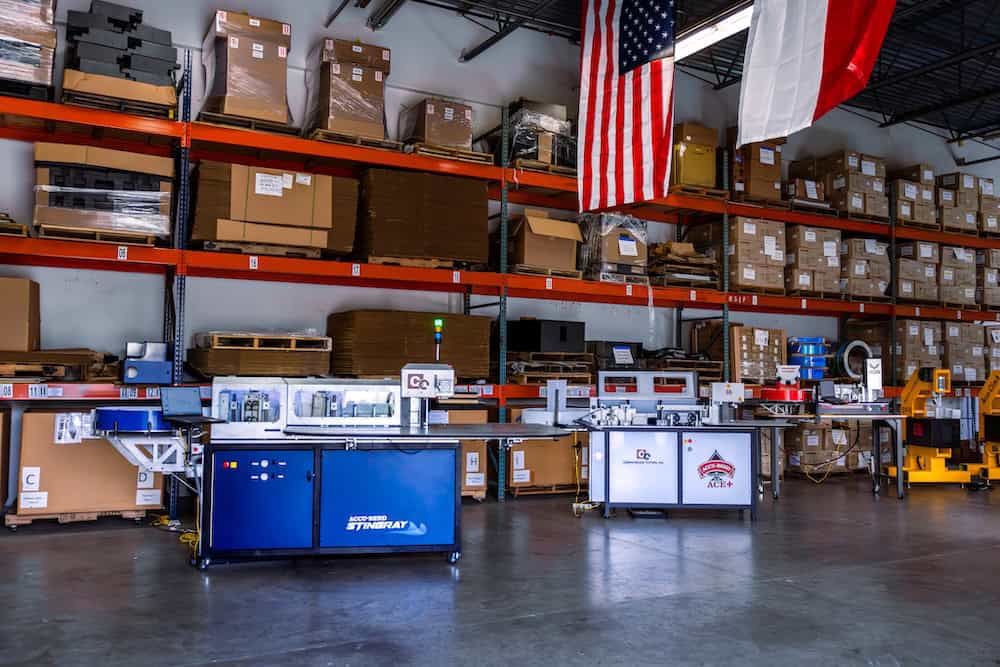
The complete fabrication process of channel letters has evolved enormously, from a series of tedious, hand-executed tasks into a streamlined, fully automated workflow that dramatically boosts productivity, enhances consistency, and significantly reduces labor costs. Today’s sign fabricators, whether small shops or large operations, can benefit from a complete channel letter production line under one roof using advanced channel letter machines from Computerized Cutters.
In today’s fast-paced sign-making industry, speed and precision determine whether a job is won or lost. Automated channel letter equipment, from advanced bending and trim cap notching systems to Accu-Cut XLR8 CNC Router Tables for precise cutting and final assembly machines, operates together to deliver outstanding performance. Understanding how each machine integrates within a fully automated workflow is critical for any sign shop aiming to optimize its production schedule and boost profit margins.
A New Era of Automation in Channel Letter Fabrication
Historically, sign shops relied on skilled labor to manually form the metal returns, cut letter faces, and apply trim components, processes that were both time-consuming and prone to inconsistency. Today, specialized channel letter machines, such as the high-performance Accu-Bend series for metal bending and flanging, have transformed production. These machines not only reduce costs by cutting production time by as much as 75%, but also work seamlessly with Accu-Cut XLR8 CNC Router Tables for precise cutting of letter faces and backs. In doing so, many sub-processes can be consolidated into one reliable and efficient production line.
Automated systems typically include a bending component for forming the metal returns and an optional trim cap module that notches and shapes plastic materials. The powerful combination of the Accu-Bend series and Accu-Cut XLR8 CNC Router Tables allows fabricators to process various substrates, from aluminum to acrylic, with consistent, high-quality results. A clinical approach to assembly, utilizing clinching or self-piercing riveting machines, further enhances the final steps, delivering a product that is dust-free and weather resistant for both indoor and outdoor signage.
Integrating Every Step: The Complete Automation Workflow
Building a complete automation workflow involves several integral steps:
1. Channel Letter Bending
The process begins with machines engineered to bend aluminum coil into the returns, the three-dimensional sides of each channel letter. Modern channel letter benders from Computerized Cutters, such as the Accu-Bend series, are designed to accommodate both standard and heavy-gauge aluminum, enabling even the most complex and large-scale letters to be fabricated in-house.
2. Trim Cap Fabrication
Once the metal returns are prepared, automated trim cap machines take over. These machines not only notch and shape plastic trim with precision but also eliminate the repetitive, error-prone task of manual measuring and cutting, ensuring that every channel letter delivers a clean, uniform finish.
3. CNC Routing for Letter Faces and Backs
Precision is paramount for cutting acrylic, composite faces, and aluminum backs. The Accu-Cut XLR8 CNC Router Tables feature high-speed virtual controllers and intuitive software that allow for accurate cutting of various substrates, reducing the need to outsource these tasks.
4. Assembly Fastening
The final phase of production involves assembling the channel letter components. Advanced fastening systems, such as clinching machines and self-piercing riveting machines, secure the pieces without requiring additional consumables like rivets or screws. This automated assembly ensures a consistent, professional finish and greatly reduces production time.
5. Software Integration and Workflow Optimization
The seamless integration of individual machines is achieved through advanced software solutions that drive the entire workflow. File imports allow for digital designs to be sent directly to the machines with minimal intervention, reducing redundant manual input and ensuring consistent replication of intricate fonts or large-scale lettering every time.
The Advantages of a Fully Automated Production Line
Investing in a fully automated production line offers significant benefits:
• Dramatically reduced lead times: what once required hours of manual labor can now be completed in mere minutes, enabling sign shops to meet strict deadlines.
• Enhanced consistency: automated systems produce uniform results that minimize errors, reducing rework and waste.
• Simplified workflow management: with digitally integrated processes (often using standardized file formats like DXF and AI), even less experienced staff can oversee production efficiently, as the automation effectively acts as an additional highly skilled worker.
• Increased output: a single production line can produce dozens or even hundreds of channel letters in one shift, boosting profitability by minimizing outsourcing and labor costs.
Economic Benefits and Increased Profitability
Automation not only reduces labor expenses but also minimizes costly errors, ensuring an impressive return on investment. By handling production entirely in-house, sign shops gain greater control over quality and scheduling. This reliable and efficient operation translates into predictable delivery times, consistent aesthetics, and stronger customer trust, all of which can forge long-term business relationships.
Future-Proofing the Business
Staying competitive in today’s market means anticipating technological innovations that impact production. An in-house automation workflow addresses current challenges such as labor shortages and fast turnaround expectations, while also providing a scalable solution for future growth. Upgrading technology, whether through faster routing speeds or enhanced material handling, can be seamlessly integrated into this automated ecosystem, ensuring that your sign shop remains at the forefront of the industry.
Implementing an Integrated Workflow: Best Practices
For sign shops considering an integrated channel letter production line, these best practices can facilitate a smooth transition:
• Adopt a systems approach: Identify the most time-consuming processes and invest in machines that specifically address those challenges.
• Invest in integrated software: Ensure that digital designs can be directly transferred to physical machines, reducing the need for manual adjustments.
• Train your team: Modern systems are designed for ease of use, allowing new operators to quickly become proficient with minimal training.
• Regularly review production quality: The consistency provided by automation makes it easier to spot and correct any issues, ensuring every channel letter meets the highest standards.
Conclusion
The ultimate guide to channel letter machines is not merely about a single piece of equipment; it’s about creating an ecosystem of automation solutions that work in harmony. By integrating specialized channel letter benders like the Accu-Bend series, Accu-Trim Edge trim cap machines, Accu-Clinch letter back fasteners, and Accu-Cut XLR8 CNC Router Tables into one cohesive workflow, sign fabricators can transform their production processes. The result is enhanced efficiency, significant cost and labor savings, improved product consistency, and a production system that is flexible enough to grow with your business.
For sign shops looking to take full control of every aspect of their production process, and ultimately boost their profitability, investing in this comprehensive automated workflow from Computerized Cutters is a smart and future-proof decision.