


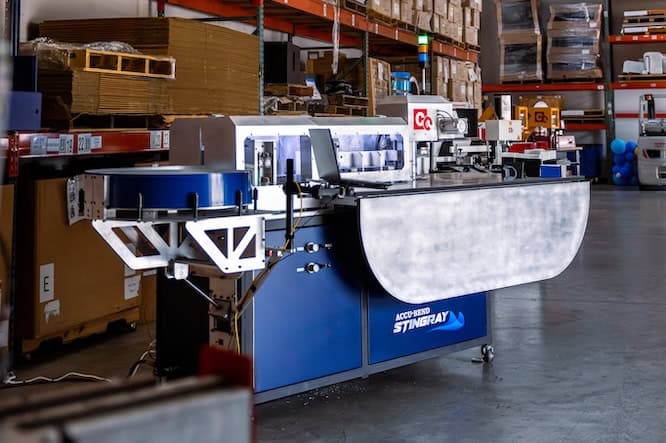
A 200-letter order lands on your desk Monday morning. The client wants channel letters for a strip mall facade, a mix of block letters and a few script logos. You need to quote a delivery date. Here is how the timeline breaks down on the Accu-Bend Stingray, and why the numbers matter more than any marketing claim.
The Scenario: 200 Letters in One Production Run
Assume the order includes 160 standard block letters (A-Z characters between 12 and 24 inches tall) and 40 script or cursive letters with tighter radii and more complex bend sequences. The material is 0.040-inch aluminum coil. Your operator arrives at 7:00 AM with the DXF files already prepared.
By 7:15 AM, the first file is imported and the first coil is loaded. Over the next one to two days, the entire order is bent, notched, flanged, and offloaded while running unsupervised at times. That still leaves time for assembly, wiring, and finishing well ahead of a Friday ship date. Below is how each phase contributes to that timeline.
Letters Per Hour: Block vs. Script
Production speed on the Stingray depends heavily on letter complexity. Simple block letters (characters with straight segments and wide-radius curves) run on average anywhere from 15 to 25 letters per hour for standard 18-inch faces. Each letter involves fewer individual bends, shorter bend sequences, and minimal tight-radius work.
Script and cursive letters slow the pace. Continuous curves, tight inside radii as small as 3/8 of an inch, and longer perimeter lengths per character reduce throughput to roughly 8 to 15 letters per hour, depending on the design. The dual bending arms maintain accuracy at these tighter tolerances, but the sheer number of bends per letter adds cycle time.
Our technicians ran a time study across our line of Accu-Bend machines on two sample letters. See below:
| Accu-Bend Model | 17-Inch “5” (min:sec per letter) | 24.5-Inch “f” (min:sec per letter) |
|---|---|---|
| Accu-Bend Stingray | 6:26 | 3:25 |
| Accu-Bend ACE+ | 8:23 | 5:19 |
| Accu-Bend Freedom | 10:04 | 6:31 |
At those times, the Stingray produces roughly 17 of the 24.5-inch “f” per hour, within the block-letter range above, and about 9 of the curve-heavy “5” per hour, in line with script-style work.
For our 200-letter scenario, expect roughly 6.5 to 11 hours for the 160 block letters (at 15-25 per hour) and 3 to 5 hours for the 40 script letters (at 8-15 per hour), for approximately 9 to 16 hours of active bending time, typically spanning 1 to 2 production days. This aligns with the Stingray’s published capacity of over 150 letters per day for typical production runs. Actual speeds vary by letter size and complexity.
Setup Time: File Import to First Bend
Setup is where many older machines lose time. On the Stingray, importing a DXF or Adobe Illustrator (AI) file takes under five minutes. The built-in software reads the vector paths, calculates the bend sequence, and displays a preview on screen. The operator confirms material thickness, selects the coil type and start and end points, and initiates the run.
From powering on the machine to bending the first letter, total setup from power-on to first bend typically runs anywhere from 8 to 12 minutes depending on the size of your letter. That includes loading the coil onto the automated coil lift and threading the material into the feed. If you are running the same material and file format from a previous job, setup drops even further because the machine retains material profiles.
Coil Change Time: Automated Lift vs. Manual Loading
A 200-letter order may require two or three coil changes, depending on coil length and letter size. On machines without an automated coil lift system, swapping a 200-pound coil is a two-person job that often takes 10 or more minutes per change and introduces a fatigue factor across long shifts.
The Stingray’s automated coil lift handles coils up to 200 pounds with a single operator. The lift positions the coil at the correct feed height, and threading into the machine typically takes roughly two to four minutes. Over multiple coil changes, that saves substantial time compared to manual loading, time that compounds across multi-day production schedules.
Unattended Operation: Run Your Machine Unmanned
One of the largest time savings comes not from faster bending but from the ability to run unattended for letters up to three feet tall. Simply press run and walk away to work elsewhere while your job runs. The machine’s dual bending arms and expandable pneumatic offload table are what make this possible. In our scenario, the block letters averaging 12 to 24 inches fit well within the offload table’s capacity. An operator could program multiple letters at one time and click run, freeing up time to work on more complex tasks that do require active monitoring.
Speed Comparison: Stingray vs. Alternatives
The following comparison uses the same 200-letter order as a baseline:
Manual bending by a skilled fabricator typically produces only 1-2 letters per hour, likely requiring two or more weeks for 200 letters and two experienced operators. The Stingray, with its dual arm system and automated material handling, processes the order in approximately 9 to 16 hours of active bending time, with the option to shift portions of the run to unattended overnight production.
When factoring in setup, coil changes, and offloading, the Stingray’s total job time for 200 letters comes in at roughly 1 to 2 working days, compared to two or more weeks using outdated equipment or manual methods.
What the Numbers Mean for Scheduling
Speed benchmarks matter most when they translate into scheduling confidence. A fabrication shop that can reliably quote a 200-letter order with a turnaround of a week or less holds a significant advantage when bidding on commercial projects with tight deadlines. The Stingray’s consistent throughput, not just its peak speed, is what makes that reliability possible.
For shops running multiple orders per week, the cumulative effect is substantial. Faster per-letter cycle times, shorter coil changes, and overnight unattended runs mean higher weekly output from the same floor space and staffing level.
To discuss production benchmarks for your specific letter volumes, or to schedule a live demonstration, contact Computerized Cutters, Inc. at 972-422-6900.